

HellishDollars

Wednesday, July 15, 2009

0 comments

Konbaung (1752 – 1885)


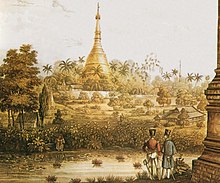
King Alaungpaya (1752 – 1760), established the Konbaung Dynasty in Shwebo in 1752.[30] He founded Yangon in 1755. By his death in 1760, Alaungpaya had reunified the country. In 1767, King Hsinbyushin (1763 – 1777) sacked Ayutthya. The Qing Dynasty of China invaded four times from 1765 to 1769 without success. The Chinese invasions allowed the new Siamese kingdom based in Bangkok to repel the Burmese out of Siam by the late 1770s.

King Bodawpaya (1782 – 1819) failed repeatedly to reconquer Siam in 1780s and 1790s. Bodawpaya did manage to capture the western kingdom of Rakhine, which had been largely independent since the fall of Bagan, in 1784. Bodawpaya also formally annexed Manipur, a rebellion-prone protectorate, in 1813.

King Bagyidaw's (1819 – 1837) general Maha Bandula put down a rebellion in Manipur in 1819 and captured then independent kingdom of Assam in 1819 (again in 1821). The new conquests brought the Burmese adjacent to the British India. The British defeated the Burmese in the First Anglo-Burmese War (1824 – 1826). Burma had to cede Assam, Manipur, Rakhine (Arakan) and Tanintharyi (Tenessarim).

In 1852, the British attacked a much weakened Burma during a Burmese palace power struggle. After the Second Anglo-Burmese War, which lasted 3 months, the British had captured the remaining coastal provinces: Ayeyarwady, Yangon and Bago, naming the territories as Lower Burma.

King Mindon (1853 – 1878) founded Mandalay in 1859 and made it his capital. He skillfully navigated the growing threats posed by the competing interests of Britain and France. In the process, Mindon had to renounce Kayah (Karenni) states in 1875. His successor, King Thibaw (1878 – 1885), was largely ineffectual. In 1885, the British, alarmed by the French conquest of neighboring Laos, occupied Upper Burma. The Third Anglo-Burmese War (1885) lasted a mere one month insofar as capturing the capital Mandalay was concerned. The Burmese royal family was exiled to Ratnagiri, India. British forces spent at least another four years pacifying the country – not only in the Burman heartland but also in the Shan, Chin and Kachin hill areas. By some accounts, minor insurrections did not end until 1896.

0 comments

Taungoo (1531 – 1752)

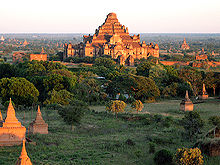
Reinforced by fleeing Burmans from Ava, the minor Burman kingdom of Taungoo under its young, ambitious king Tabinshwehti (1531 – 1551) defeated the more powerful Mon kingdom at Bago, reunifying all of Lower Burma by 1540. Tabinshwehti's successor King Bayinnaung (1551-1581) would go on to conquer Upper Burma (1555), Manipur (1556), Shan states (1557), Chiang Mai (1557), Ayutthaya (1564, 1569) and Lan Xang (1574), bringing most of western South East Asia under his rule. Bayinnaung died in 1581, preparing to invade Rakhine, a maritime power controlling the entire coastline west of Rakhine Yoma, up to Chittagong province in Bengal.

Bayinnaung's massive empire unraveled soon after his death in 1581. Ayutthaya Siamese had driven out the Burmese by 1593 and went on to take Tanintharyi. In 1599, Rakhine forces aided by the Portuguese mercenaries sacked the kingdom's capital Bago. Chief Portuguese mercenary Filipe de Brito e Nicote (Burmese: Nga Zinga) promptly rebelled against his Rakhine masters and established Portuguese rule in Thanlyin (Syriam), then the most important seaport in Burma. The country was in chaos.

The Burmese under King Anaukpetlun (1605-1628) regrouped and defeated the Portuguese in 1611. Anaukpetlun reestablished a smaller reconstituted kingdom based in Ava covering Upper Burma, Lower Burma and Shan states (but without Rakhine or Taninthayi). After the reign of King Thalun (1629 – 1648), who rebuilt the war-torn country, the kingdom experienced a slow and steady decline for the next 100 years. The Mons successfully rebelled starting in 1740 with French help and Siamese encouragement, broke away Lower Burma by 1747, and finally put an end to the House of Taungoo in 1752 when they took Ava.

0 comments

Small kingdoms (1287 – 1531)


The Mongols could not stay for long in the searing Ayeyarwady valley. But the Tai-Shan people from Yunnan who came down with the Mongols fanned out to the Ayeyarwady valley, Shan states, Laos, Siam and Assam, and became powerful players in Southeast Asia.

The Bagan empire was irreparably broken up into several small kingdoms:

  • The Burman kingdom of Ava or Innwa (1364 – 1555), the successor state to three smaller kingdoms founded by Burmanized Shan kings, controlling Upper Burma (without the Shan states)
  • The Mon kingdom of Hanthawady Pegu or Bago (1287 – 1540), founded by a Mon-ized Shan King Wareru (1287 – 1306), controlling Lower Burma (without Taninthayi).
  • The Rakhine kingdom of Mrauk U (1434 – 1784), in the west.
  • Several Shan states in the Shan hills in the east and the Kachin hills in the north while the northwestern frontier of present Chin hills still disconnected yet.

This period was characterized by constant warfare between Ava and Bago, and to a lesser extent, Ava and the Shans. Ava briefly controlled Rakhine (1379 – 1430) and came close to defeating Bago a few times, but could never quite reassemble the lost empire. Nevertheless, Burmese culture entered a golden age. Hanthawady Bago prospered. Bago's Queen Shin Saw Bu (1453 – 1472) raised the gilded Shwedagon Pagoda to its present height.

By the late 15th century, constant warfare had left Ava greatly weakened. Its peripheral areas became either independent or autonomous. In 1486, King Minkyinyo (1486 – 1531) of Taungoo broke away from Ava and established a small independent kingdom. In 1527, Mohnyin (Shan: Mong Yang) Shans finally captured Ava, upsetting the delicate power balance that had existed for nearly two centuries. The Shans would rule Upper Burma until 1555.

Tuesday, July 14, 2009

0 comments

Traditional food


Myanmar food has its own special identity. Although it draws on its' neighbors, it is neither as hot as Thai, as spicy as Indian nor does it resemble Chinese cooking much except in the stir-fry vegetables. Nowadays various kinds of Myanmar food and snacks are available in the street stalls, market stalls and local restaurants. Also most of hotels in different destinations offer Myanmar set menus, which allows visitors to try the taste of the Myanmar cuisine.

Myanmar dining tables are round and low-footed. Family members sit on the mat around the table to have meals. Unlike the Western kitchen, food is not served in courses. Dishes with different items are spread out on the table for people to take themselves form onto their plates. Food is eaten with the fingers of the right hand. Homes in cities and towns have dining tables and chairs, some people eat with fork and spoon.

Traditional Myanmar Breakfast
It can be all sorts of food. Most of Myanmar families have fried rice and peas for breakfast. A pot of plain tea is a must on the dining table. Also Mohingar, Nangyi thoat, Ohn No Kauk Swe, noodle and vermicelli salad with sauce, steamed sticky rice and deep-fried vegetables with creamy rice powder are breakfast items. Some have Myanmar traditional snacks such as bain mont and mont sein baung.

All Myanmar snacks are made of rice or sticky rice powder. Some snacks of rice powder are mixed with jaggery and baked, steamed or fried.

Bain Mont : Baked creamy rice powder mixing with jaggery liquid. Sliced peanuts, coconut and poppy seeds are spread over it during baking. It has a form of pan cakes and the taste is sweet.

Mont Sein Baung : Steamed creamy rice-powder with jaggery liquid. It includes two layers, the upper white one is just steamed creamy rice-powder and the lower brown part is steamed rice powder mixed with liquid jaggery. Thin sliced coconut and pounded sesame seeds are added when served.

Mont Hin Gar : Well known Myanmar cuisine which most of Yangon's people have every morning as breakfast. It is a mixing of the thick fish soup and thin rice noodles. Roasted Chilly powder, a squeezed lemon, fish sauce and coriander are added for more appetite.

Ohn Nok Kauk Swe : Noodles with chicken and coconut soup. Slices of onion, yellowish fried rice cracker, a squeeze of lemon and roasted chilly powder are added for more taste.

Typical Lunch or Dinner
The meal is arranged around rice with accompanying curry as main dish with a side dish and soup.

The main dish features pork, beef, mutton, chicken, duck, fish or prawn, eggs cooked in onions, and a gravy that is based on garlic, ginger, saffron powder, shrimp sauce or soy sauce, salt and a little bit of chilly powder. The meat can be fried, stewed, steamed or roasted.

Side dishes are usually a salad or fried vegetables. A salad is normally made with vegetables combined with onion slices, pounded peanuts, pounded dried-shrimp, salt or shrimp sauce and oil. Pickled tealeaf or ginger salads are eaten often after meals or as afternoon snacks.

Soups may be clear, refreshingly tart or creamy. They are mostly with vegetables, sometimes with meat, fish or prawns create different tastes. Sour soup made with roselle-leaves, bamboo shoot and fish is a popular and common soup of the Myanmar cuisine.

Fresh fruits are served after the meals. Myanmar is very rich on tasty tropical fruits in their many varieties, pineapple, papaya, mango, melons, banana, orange, etc.

Ngapi
Ngapi means pressed fish. Fish paste and shrimp paste are two kinds of Ngapi. Shrimp paste is shrimps crushed with salt into fairly dry paste. It is used in most dishes, especially in rosella soup. Another common side dish is fried Ngapi (Balachaung). It is fried shrimp paste with pounded dried shrimp, crushed garlic and onions and chilies. Another shrimp paste dish is roasted shrimp paste with peanut oil and a squeezed lemon.

Ngapi Yae Kyo : It is also a popular Myanmar side dish, which can be made from a kind of fish paste including big pieces of fish. The fish paste is boiling with saffron until it becomes thick. Pounded dried shrimp or crashed cooked fish, pounded garlic, roasted crashed tomatoes and chilies are combined with it. It is eaten with a variety of vegetables either raw or boiled (called toh-sayar).

0 comments

Transportations


Field info displayed for all countries in alpha order.
84 (2008)
country comparison to the world: 70

Field info displayed for all countries in alpha order.
total: 31
over 3,047 m: 10
2,438 to 3,047 m: 10
1,524 to 2,437 m: 9
under 914 m: 2 (2008)

Field info displayed for all countries in alpha order.
total: 53
over 3,047 m: 1
1,524 to 2,437 m: 9
914 to 1,523 m: 13
under 914 m: 30 (2008)

Field info displayed for all countries in alpha order.
4 (2007)

Field info displayed for all countries in alpha order.
gas 2,228 km; oil 558 km (2008)

Field info displayed for all countries in alpha order.
total: 3,955 km
country comparison to the world: 44
narrow gauge: 3,955 km 1.000-m gauge (2006)

Field info displayed for all countries in alpha order.
total: 27,000 km
country comparison to the world: 102
paved: 3,200 km
unpaved: 23,800 km (2006)

Field info displayed for all countries in alpha order.
12,800 km (2008)
country comparison to the world: 11
0 comments

Communications

Field info displayed for all countries in alpha order.
503,900 (2005)
country comparison to the world: 97

Field info displayed for all countries in alpha order.
214,200 (2006)
country comparison to the world: 167

Field info displayed for all countries in alpha order.
general assessment: meets minimum requirements for local and intercity service for business and government
domestic: system barely capable of providing basic service; cellular phone system is grossly underdeveloped with a subscribership base of less than 1 per 100 persons
international: country code - 95; landing point for the SEA-ME-WE-3 optical telecommunications submarine cable that provides links to Asia, the Middle East, and Europe; satellite earth stations - 2, Intelsat (Indian Ocean) and ShinSat (2007)

Field info displayed for all countries in alpha order.
AM 1, FM 2, shortwave 3 (2007)

Field info displayed for all countries in alpha order.
4 (2008)

Field info displayed for all countries in alpha order.
.mm

Field info displayed for all countries in alpha order.
108 (2008)
country comparison to the world: 187

Field info displayed for all countries in alpha order.
40,000 (2007)
country comparison to the world: 169